
Transcription for Interviews and Research
Qualitative research runs on interviews and focus groups, and the recordings add up fast. Consent forms promise participants a confidentiality that is hard to keep once audio is uploaded to someone else’s cloud. Scriber runs on your institution's own server, so the recordings never have to leave it.
Hours of Tape, Kept In-House
A single day of fieldwork can produce hours of interview or focus-group recordings. Transcribing that material by hand takes far longer than the conversations themselves, and the backlog grows with every session added to the project.
Participant consent forms and institutional data policies often rule out uploading audio to a cloud transcription service. Scriber is installed on your institution's own server and processes every recording there, so the material never has to leave the building to become a transcript.
Speaker-Separated by Default
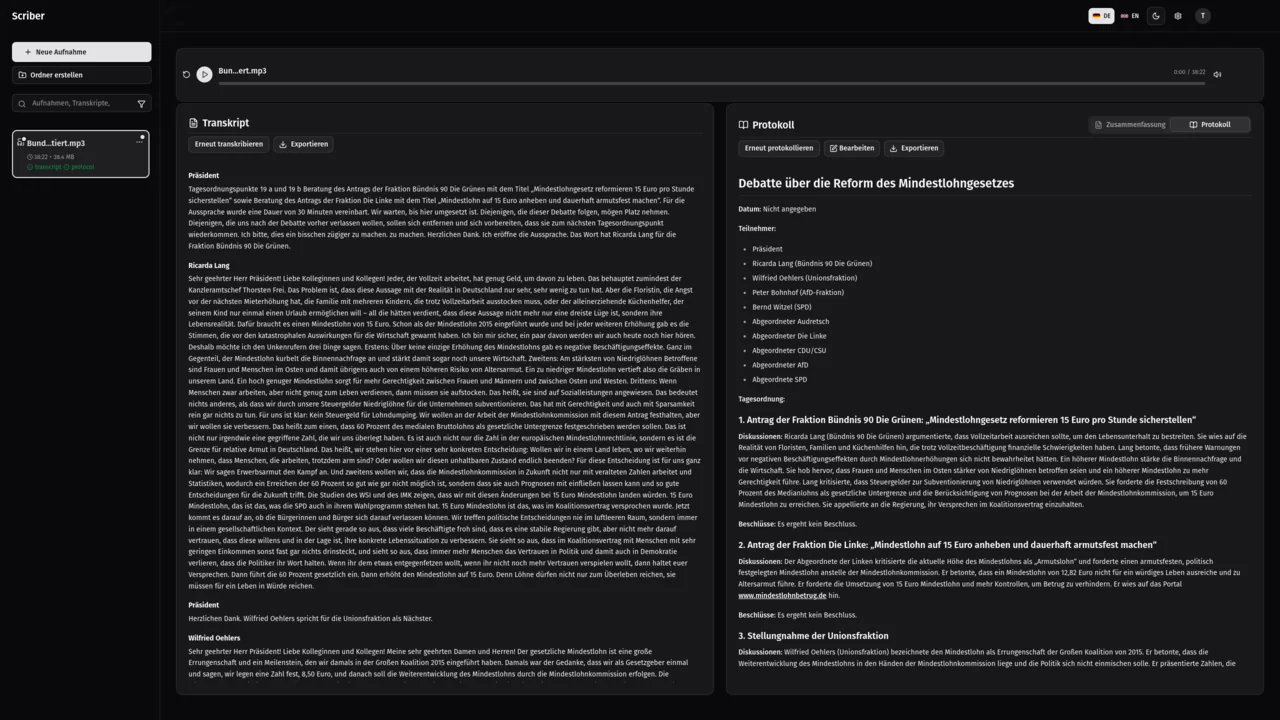
In a focus group, who said something matters as much as what was said. Scriber's own speaker-separation model attributes each contribution to the person who made it, without manual labelling.
The result is a transcript you can quote with confidence in a paper or a report: statements stay attached to the participant who made them, turn by turn, through the whole recording.
A Batch of Recordings, Transcribed on Their Own
Field recordings rarely arrive one at a time. Scriber accepts them by manual upload, from a watched folder on the server, from an S3-compatible bucket, or from a network share, and works through whatever arrives without anyone opening the application.
Once a batch is transcribed, search across the whole library to find a passage instead of scrubbing through individual audio files.
Collect
Recordings come in from interviews and focus groups conducted in the field.
Ingest
Files reach Scriber by upload, a watched folder, an S3-compatible bucket, or a network share.
Transcribe
Each recording is transcribed and speaker-separated as it arrives, without anyone opening the application.
Analyse
Search the library for a passage, then export it into your coding workflow.
Into Your Analysis Tools
A finished transcript is only useful if it moves into the tools you already use for coding and analysis. Export as plain text, Markdown, JSON, Word, or PDF, and bring interview and focus-group material into your existing workflow without reformatting it by hand.
Project meetings generate their own record. Scriber turns those into a summary and finished minutes as well, so the research team's internal discussions are as easy to revisit as the interview data itself.
Frequently Asked Questions
Can Scriber transcribe qualitative research interviews?
Yes. Scriber transcribes interview and focus-group recordings on your institution's own server, word for word, with each contribution attributed to its speaker. The transcript is ready for coding and analysis, and nothing about the recording or the resulting text leaves your infrastructure at any point.
How are speakers in a focus group told apart?
Each contribution in a focus-group recording is attributed to its speaker by Scriber's own speaker-separation model, automatically, as the recording is transcribed. Statements stay attached to the person who made them throughout the transcript, so the record can be quoted with confidence in analysis or publication.
Can we transcribe a whole archive of recordings?
Yes. Point a watched folder on the server, an S3-compatible bucket, or a network share at your archive, and Scriber transcribes each recording unattended as it works through the material. Every result lands in one searchable library, so you can find a passage across the whole archive rather than one file at a time.
What do participants' consent forms need to account for?
Because processing happens only on your institution's own infrastructure, no third-party processor ever receives the audio, and no recording is transmitted elsewhere. Storage, retention, and deletion remain decisions your institution makes on its own systems. That supports the confidentiality most consent forms promise participants; the exact wording remains a question for your ethics board.
Keep Your Research Data In-House
Talk to us about transcribing your interviews and focus groups on your own infrastructure.